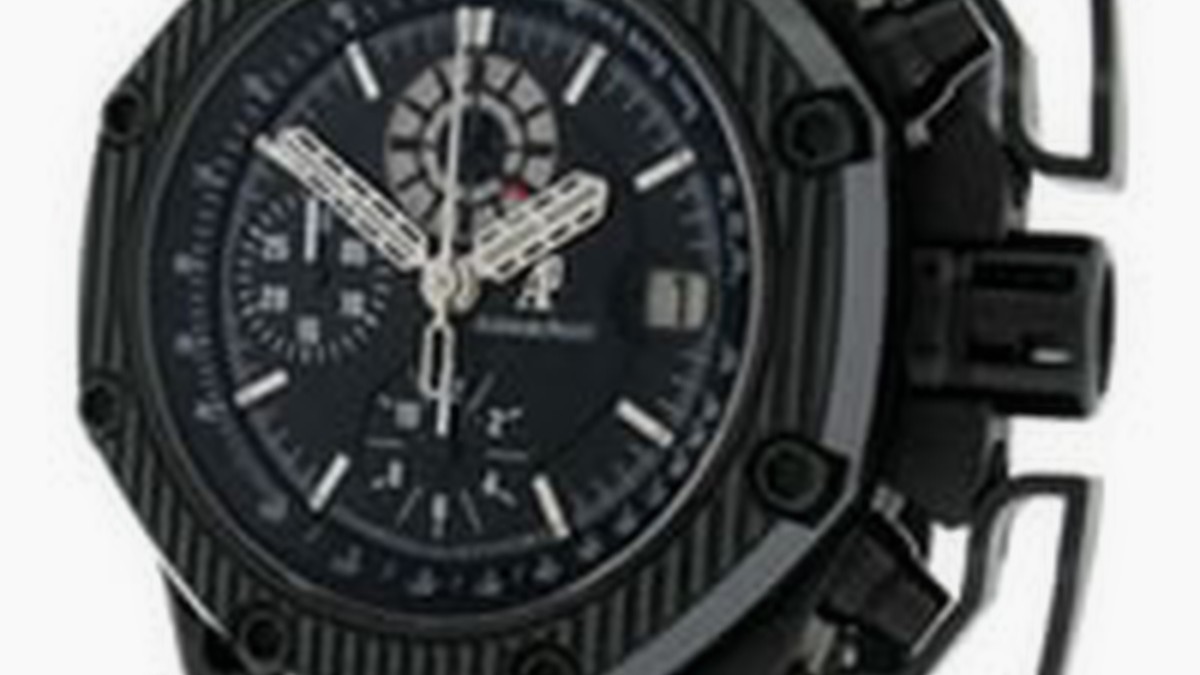
The Offshore is a family, not one oversized watch
The original site mixed details from different Offshore configurations into the homepage: rubber straps, chronograph subdials, rose-gold pushers and oversized dimensions. Those features can all appear within the Offshore universe, but they should not be blended into one universal specification. Older 42–44 mm generations and the modern 43 mm 26420 family need separate baselines.
Modern 43 mm 26420 baseline
Current 26420 Royal Oak Offshore Selfwinding Chronographs use a 43 mm format and Calibre 4401. AP lists a 70-hour power reserve, 28,800 vph frequency and flyback chronograph functions on current references. Modern 26420 configurations also commonly feature Méga Tapisserie dials and interchangeable strap systems.
A replica does not have to reproduce Calibre 4401 architecture to be useful, but sellers should not use the 4401 name as a generic synonym for “high quality.” Ask whether the movement is a functional chronograph, how the subdials are driven and whether the case thickness reflects the movement inside.
Older 42–44 mm eras require their own photos
Earlier Offshore references used different cases, pushers, straps and movement architectures. A photograph of a modern 43 mm watch cannot validate an older 44 mm limited-edition build. When buying older-style replicas, request the exact reference or at least enough configuration details to establish the correct baseline.
Chronograph geometry is a first-line test
Look at subdial radius, vertical and horizontal spacing, hand length and the relation between counters and date window. If the movement architecture forces subdials inward or outward, the dial may never look correct even if printing quality is excellent.
Rubber changes the case stance
Rubber straps are not merely accessories on an Offshore. The way the strap leaves the case, the curvature near the lugs and the buckle construction all affect wrist stance. A stiff replacement strap can make a correctly sized case wear much larger.
Offshore buying matrix
| Priority | What to inspect | Common compromise |
|---|---|---|
| Visual accuracy | Subdial spacing, pushers, crown, Méga Tapisserie | Generic chronograph architecture |
| Wearability | Thickness, strap curvature, buckle | Top-heavy case or stiff strap |
| Function | Start/stop/reset, date, winding | Decorative/non-functional counters |
| Durability | Pusher seals, crown, strap hardware | Water claims without individual testing |
Choose Offshore when the bulk is part of the appeal
If the main attraction is a slim integrated bracelet, a classic Royal Oak is the better direction. Offshore makes sense when the oversized chronograph architecture, rubber/strap options and more aggressive dial are the point—not when you simply want “the biggest AP.”
Pusher feel is part of chronograph quality
On a functional chronograph, the pushers should engage consistently. Excessive stiffness, vague engagement or a reset that leaves the central chronograph hand off zero can indicate adjustment issues. Video is useful here because still photographs cannot show the action.
Caseback thickness can reveal movement substitution
Chronograph movements vary substantially in thickness. When a replica uses a movement that differs from the target architecture, factories may compensate with a deeper caseback or taller case. Compare side-profile photos with the target reference before accepting a movement claim based only on caseback engraving.
Interchangeable strap systems add another QC point
On modern Offshore-inspired builds, check how securely the strap interface locks and whether both sides sit at the same angle. A loose or uneven interface affects comfort and can become a durability problem. Replacement strap availability also matters if the system is proprietary.
Older limited editions deserve their own baseline
Do not use a 26420 checklist for every Offshore. Survivor-style, Schumacher-style and other earlier limited editions have their own case, pusher, material and dial details. When the reference is older, find reference-specific photos before approving QC.
Chronograph reset is a better test than a static caseback
Movement decoration attracts attention, but a functional chronograph reveals more about setup. Start the chronograph, let it run long enough for the counters to move, stop it and reset. The central hand should return cleanly, and the counters should return to their zero positions. Repeated weak resets or hands that miss zero deserve more attention than decorative engravings.
For an Offshore intended as a daily watch, also test how easy the crown and pushers are to use on the wrist. Oversized cases can make controls uncomfortable if their geometry is wrong, even when they look close in photos.